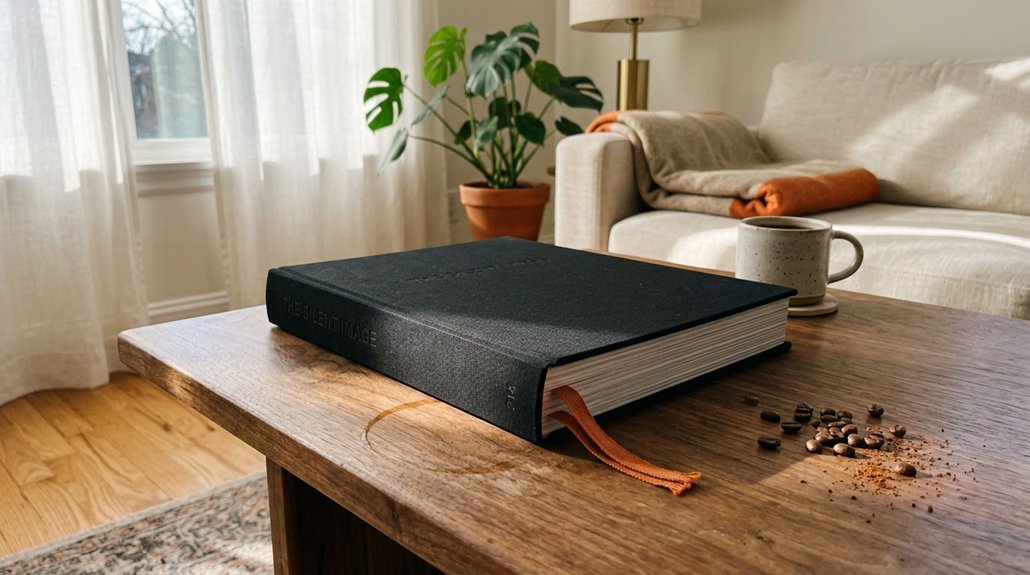
A well-chosen coffee table book is a window you leave open for guests, and in 2026, five titles deserve that prime real estate.
You’ll find Walk With Me captures New York’s unguarded moments with a lay-flat binding that won’t fight you during sharing.
Let’s Get Lost packs remote wonders into a travel-friendly size, though its smaller format sacrifices some impact.
The Creative Act offers no photos, just daily creative philosophy, which feels bold or disappointing depending on your shelf’s purpose.
Architectural Digest at 100 serves design historians with century-spanning interiors, while In Vogue delivers fashion history through illustration rather than photography, a curious choice for this list.
Each demands different space, budget, and intent.
Walk With Me: New York Street Photography

You open this 176-page Abrams hardcover and you’re walking. Not touring, not sightseeing, just walking. The photographer catches what you’d catch if you weren’t checking your phone: a taxi door half-open, steam rising past a neon sign, some stranger’s laugh frozen mid-breath.
It’s street photography at its most honest, no staging, no posturing. Published 2022, it’s recent enough to feel alive, old enough to prove it isn’t chasing trends.
You get 176 pages of visual diary. No essays weighing you down. The binding holds flat, which matters when you’re showing guests that shot of rain on subway steps.
Here’s who needs this: You collect urban photography, you’ve never loved New York, or you’ve never left. It works for all three. The weakness? If you want technique breakdowns or photographer notes, you won’t find them. This is pure image, pure moment.
Sometimes that’s exactly what your coffee table needs.
Best For: Photography enthusiasts, urban life appreciators, and anyone seeking an unfiltered visual meditation on everyday New York moments without the weight of technical commentary or tourist spectacle.
Pros:
- Captures authentic, unstaged street photography that rewards patient observation and repeat viewing
- Lays flat when open, making it practical for casual browsing and showing photographs to others
- Serves multiple audiences equally well: collectors, New York skeptics, and devoted locals
Cons:
- Contains no photographer notes or technique breakdowns for those seeking educational insight
- Offers no contextual essays that might deepen understanding of the images or their creation
- Prioritizes mood over instruction, which may disappoint readers wanting actionable photography guidance
Recommended Products


Let’s Get Lost: the world’s most stunning remote locations

Need a break from crowded hotspots? You’ll find your escape in *Let’s Get Lost: the world’s most stunning remote locations*, a 240-page hardcover from White Lion Publishing that dropped in late 2021. This compact volume packs serious wanderlust into its travel-friendly size.
What You’re Getting
White Lion built this for explorers who crave untouched places. You’ll page through remote landscapes, dramatic terrain, and hidden corners most travelers never reach.
The photography captures raw natural beauty without the tourist clutter.
The Reality Check
At 240 pages, it’s slimmer than epic tomes, so you’ll want more depth if you’re a hardcore geography buff.
The 2021 publication date means some locations may have changed access since printing. Binding holds up to repeated browsing, though.
Who Benefits
Buy this if you’re planning future trips or simply need visual relief from your daily grind. Skip it if you want urban energy or exhaustive cultural context.
It works best as inspiration fuel, not definitive guide.
Bottom Line
Grab it when you need remoteness without the plane ticket. You’ll return to these images whenever city life overwhelms you.
Best For: Travelers seeking visual inspiration and escape to remote, unspoiled destinations without the crowds of typical tourist hotspots.
Pros:
- Stunning photography capturing raw natural beauty in untouched locations
- Compact 240-page hardcover format that’s travel-friendly and durable for repeated browsing
- Published by White Lion Publishing with quality binding and presentation
Cons:
- Limited depth at 240 pages may disappoint hardcore geography or travel enthusiasts wanting exhaustive detail
- 2021 publication date means some remote locations may have changed access or conditions since printing
- Lacks urban energy and exhaustive cultural context that some travelers prioritize in guidebooks
Recommended Products

Used Book in Good Condition

Height: 13.75in / 35cm, Depth: 2in / 5cm, Width: 10.25in / 26cm

The Creative Act: A Way of Being
Seekers of substance will find solace in this 432-page hardcover, bound in silver and built for thinkers who’d rather contemplate creativity than chase trends. Penguin Press dropped this in January 2023, and it still holds weight on any photographer’s table four years later.
You’ll flip through 432 pages that treat creativity as daily practice, not magic. The silver cover catches light beautifully, though it shows fingerprints fast.
This isn’t a visual feast of images; it’s a philosophical companion for artists hitting creative walls.
Who needs this: Photographers stuck in ruts, anyone questioning why they create.
The catch: No photos inside. Zero. For a photography book list, that’s almost ironic.
Bottom line: Buy it if you want mindset shifts, skip it if you want eye candy. Grab it discounted, and you’ve got a lifetime reference that outlasts trendier titles.
Seekers of substance will find solace in this 432-page hardcover, bound in silver and built for thinkers who’d rather contemplate creativity than chase trends. Penguin Press dropped this in January 2023, and it still holds weight on any photographer’s table four years later.
You’ll flip through 432 pages that treat creativity as daily practice, not magic. The silver cover catches light beautifully, though it shows fingerprints fast.
This isn’t a visual feast of images; it’s a philosophical companion for artists hitting creative walls.
Who needs this: Photographers stuck in ruts, anyone questioning why they create.
The catch: No photos inside. Zero. For a photography book list, that’s almost ironic.
Bottom line: Buy it if you want mindset shifts, skip it if you want eye candy. Grab it discounted, and you’ve got a lifetime reference that outlasts trendier titles.
Best For: Photographers and artists stuck in creative ruts who want a philosophical companion for mindset shifts rather than visual inspiration.
Pros:
- Treats creativity as a daily practice rather than relying on magic or inspiration
- Silver hardcover design catches light beautifully as a display piece
- 432 pages of substantial content that serves as a lifetime reference outlasting trendier titles
Cons:
- Shows fingerprints quickly on the silver cover
- Contains zero photographs, which feels ironic for a photography-focused book list
Recommended Products


In Vogue: Illustrated History of Famous Fashion Magazine

This one’s for anyone who treats fashion history like family lore. “In Vogue: An Illustrated History of the World’s Most Famous Fashion Magazine” packs 444 pages of archival photography, iconic covers, and editorial milestones into a substantial hardcover that demands attention.
Rizzoli published this illustrated edition back in 2012, yet its visual storytelling holds up beautifully. You’ll find yourself lost in decades of fashion evolution, from early 20th century illustrations to modern photographic spreads. The multicolor printing does justice to every editorial decision that shaped global style.
At 444 pages, it’s hefty enough to anchor your coffee table, not your bookshelf. The binding withstands repeated flipping, though you’ll want clean hands for this one.
Who needs this? Fashion students, magazine collectors, anyone who can name five Vogue covers from memory. Skip it if you want contemporary photography; this celebrates publishing history, not camera technique.
Check the spine before buying secondhand; heavy books show wear fast.
Best For: Fashion students, magazine collectors, and anyone passionate about fashion history who appreciates archival photography and editorial milestones.
Pros:
- 444 pages of rich visual storytelling with archival photography and iconic covers spanning decades of fashion evolution
- High-quality multicolor hardcover printing that showcases editorial decisions and stands up to repeated handling
- Comprehensive coverage of Vogue’s publishing history from early 20th century illustrations to modern spreads
Cons:
- Heavy coffee-table format (444 pages) makes it impractical for bookshelf storage and prone to spine wear
- Focuses on publishing history rather than contemporary photography or camera technique
- 2012 publication date means content stops over a decade ago, missing more recent editorial developments
Recommended Products


Architectural Digest at 100: A Century of Design
Design enthusiasts craving a visual timeline of American luxury living will find their match here. *Architectural Digest at 100* packs 464 pages of celebrity homes and iconic interiors into one hefty hardcover, tracing how taste evolved from Gilded Age mansions to minimalist penthouses.
Abrams Books published this archive-driven compilation in 2019, and it still holds up. You’ll spot profiles of legendary designers alongside shots of famous residences you’ve only glimpsed in magazines.
The century-long scope means some looks feel dated; that’s the point. You’re watching American aesthetics shift in real time.
At 464 pages, this isn’t light reading. Your coffee table needs muscle. The binding holds, but shelve it spine-out; this thing dominates space.
Who needs this: Design history buffs, real estate obsessives, anyone staging a high-end home.
Skip if: You want practical decorating tips. This celebrates; it doesn’t teach.
Verdict: A visual reference you’ll actually open, not just display.
Best For: Design history enthusiasts, real estate obsessives, and anyone staging a high-end home who wants a visual timeline of American luxury living through the past century.
Pros:
- Comprehensive century-long archive showcasing the evolution of American interior aesthetics from Gilded Age mansions to minimalist penthouses
- Profiles of legendary designers paired with rare photography of famous celebrity residences
- Substantial 464-page hardcover with durable binding that functions as both reference and display piece
Cons:
- No practical decorating instruction or actionable tips for readers seeking hands-on guidance
- Physically oversized and heavy, requiring significant coffee table or shelf space
- Some content feels dated by design, which may frustrate readers looking for contemporary inspiration only
Recommended Products


Factors to Consider When Choosing Photography Coffee Table Books

You’ll want to weigh several practical factors before dropping serious cash on a photography book that’ll dominate your living room for years. Start by asking yourself whether you’re drawn to a specific photography style focus, like stark black-and-white street work or rich color landscapes, and check that the physical book quality matches the price tag; thick paper and solid binding separate the keepers from the shelf-saggers.
Don’t ignore size and display logistics either. A massive folio looks impressive until you’re rearranging furniture to accommodate it, while subject matter depth and publishing house reputation tell you if you’re buying genuine art or glossy fluff.
Recommended Products


Photography Style Focus
Your choice of photography style isn’t just about pretty pictures, it’s about what you’ll actually want to flip through for years. Ask yourself what draws you in: the raw energy of candid street scenes, the quiet pull of remote landscapes, or the polish of fashion and architectural work?
Street photography books grab you with serendipitous moments you couldn’t stage, rough textures, and daily rhythms that feel like flipping through someone’s diary. Travel volumes trade that grit for sweeping vistas and narrative captions that walk you through places you’ll probably never visit.
Fashion and illustrated histories lean on curated editorial images arranged chronologically to show how culture shifts. Some titles layer in long-form essays about creativity, giving you interpretive context so you’re not just looking, you’re understanding what the images say about human potential.
Physical Book Quality
Once you’ve settled on the style of photography that speaks to you, the book itself becomes the thing you live with. You’ll want a hardcover binding that survives years of thumbing through, not some flimsy paperback that warps by Christmas.
Check the page count: 176 pages feels light, while 464 pages delivers substantial visual density. Don’t ignore when it was printed, older releases sometimes skimp on paper stock compared to newer standards.
Flip through if you can. Does the color stand out? Are the blacks deep and true? Silver or multicolor finishes catch light beautifully on your shelf.
Finally, ask yourself: will urban landscapes or fashion spreads still draw you in five years? Pick themes with staying power.
Size and Display
Scale dictates everything. You need to decide whether you want a statement piece or something subtle. Large hardcovers with 400+ pages demand attention and shelf space, while compact 200-300 page editions slip easily onto crowded tables without overwhelming your room.
Consider weight and stability carefully. Thick, heavy books withstand frequent thumbing through, though they wobble on uneven surfaces. You will notice binding quality immediately when you lift one.
Visual presence matters at a distance. Wide layouts with breathing room catch your eye across the room, but cramped spreads look messy from afar. Full-bleed photos with bold contrast pop instantly, drawing guests in.
Page count signals staying power. Heftier volumes feel substantial enough to remain centerpieces rather than fading into background clutter.
Subject Matter Depth
How deeply do you want to go? Subject matter depth separates coffee table books you’ll flip through once from ones you’ll return to for years. You’ll find surface-level volumes packed with striking photos but little context, perfect when you want quick visual hits.
Dig deeper and you’ll discover books layered with artist notes, historical timelines, and scholarly essays that explain why each image matters. Check whether the book includes archival materials, process insights, or curatorial rationale; these elements transform pretty pictures into meaningful narratives. Consider the pacing too: thoughtful sequencing and editorial voice signal serious intent.
Ask yourself if you need theoretical framing or cultural backstory, or if pure photography satisfies you. Match the book’s depth to your curiosity and shelf space.
Publishing House Reputation
A handful of publishers dominate the photography book world, and you can spot their work without flipping a single page. Their reputation signals editorial standards and production quality, setting your expectations for image fidelity, paper stock, and binding durability.
You’ll notice established publishers maintain consistent approaches to image sequencing and captions. They deliver authoritative curatorial notes, prefaces, and endorsements that add interpretive value beyond the visuals.
Consider imprint-specific strengths when choosing. Some focus on design, others on architecture or travel photography. These specialties align with your aesthetic preferences and reliability needs.
Publisher pedigree also affects distribution, special edition availability, and potential for future reprints or companion titles. You’re not just buying a book; you’re investing in a publishing relationship that extends beyond this single purchase.
Page Count Value
What’re you actually getting when you crack open a photography book? You’re buying scope, plain and simple. Page count tells you how deep the photographer went.
Most quality coffee table books land between 176 and 464 pages. That’s your benchmark. Skinny books around 176 pages work great for visual-first collections: you flip, you absorb, you move on. But if you want essays, series context, and captions that actually explain what you’re seeing, you’ll need 300-plus pages to fit that narrative meat.
Bigger books demand hardcover bindings; anything else falls apart after three dinner parties. Match the thickness to your shelf space and your attention span.
Love long-form storytelling? Go thick. Prefer bold images with minimal reading? Stay compact. You’re paying for pages you’ll actually use.
Publication Date Relevance
Once you’ve sorted out how many pages you’re willing to handle, you should look at when the book hit the shelves. A 2025 release probably boasts sharper printing, sturdier paper, and design trends that’ll mesh with your modern setup. But don’t sleep on older gems; vintage editions from the ’70s or ’80s carry period-specific charm that anchors a collection with authentic character.
Check whether you’re grabbing a first edition or a reissue. Publishers sometimes remaster images, fix caption errors, or upgrade print quality in later versions, and that matters for accuracy and value.
Finally, match the publication era to your shelf’s theme. A gritty 1990s street photography book might clash with sleek, minimalist décor, so consider cohesion before you buy.